

Sustainability and Resilience Plan
On February 16, 2022, the Fulton County Board of Commissioners adopted updated goals for the 2019 Sustainability and Resilience Plan. The original plan with updated goals is available.
The Plan’s vision is for Fulton County to thrive as the premier county in Georgia for sustainability and resilience, protecting residents, visitors, and environmental systems. See below for more information about the Plan’s six priority areas.
Sustainability and Resiliency plan
Climate Change Mitigation has three primary goals.
1. Reduce county building energy use 50% by 2030 compared to 2018.
The Department of Real Estate and Asset Management has many projects underway that reduce energy use, including:
- Since 2018, 21 county buildings have been LEED-certified, which requires energy efficient equipment and other sustainable features. Most of these certifications were for building renovations, but some of them were for new construction, such as the new Animal Services Facility on Fulton Industrial Boulevard.
- As part of the capital renewal process, county buildings can receive HVAC, controls, and lighting upgrades. Since 2018, upgrades have been made at the Government Center, Justice Center, Juvenile Justice Center, libraries and senior centers.
Fulton County has been producing electricity with solar panels on county building roofs since 2021. Currently, the county has solar panels on over 40 buildings, with additional buildings planned. The lifetime kWh savings have reduced emissions by 5.8 million pounds of CO2e, which is equivalent to 2,644 acres of forest and 615 cars driven for one year. More information can be found on the county’s Solar Program webpage.
3. Reduce county building water use 30% by 2030 compared to 2018.
- Since 2018, 21 county buildings have been LEED-certified, which requires water efficient equipment and other sustainable features. Most of these certifications were for building renovations, but some of them were for new construction, such as the new Animal Services Facility on Fulton Industrial Boulevard.
- As part of the capital renewal process, county buildings can receive water equipment upgrades. Since 2018, water upgrades have been made at the Government Center.
Social Equity and Smart Transit has two key targets
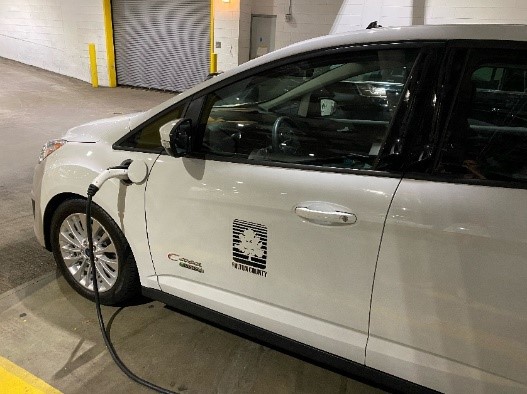
1. Transition 25% of light-duty administrative vehicles to electric vehicles (EVs) and plug-in hybrid electric vehicles by 2030.
Fulton County currently has two plug-in hybrid electric vehicles in its fleet. Each of these vehicles has their own level 1 charging station.
In 2023 Fulton County partnered with the Environmental Defense Fund to have a fellow evaluate the county’s fleet and create a Fleet Electrification Plan. The Department of Real Estate and Asset Management has used this plan to make annual budget requests for fleet EV charging stations. Once the charging stations are in place, the county can start procuring EVs for its fleet.
2. Install EV charging equipment at all viable county facilities for public and employee use.
Fulton County currently has EV charging stations for public use at two facilities: Metropolitan Library and Animal Services. For more information about public EV charging stations, please visit the county's EV Charging Station webpage.
The Department of Real Estate and Asset Management is currently pursuing a contract in which EV charging station vendors will install, own, operate, and maintain public EV charging stations on county property at no cost to the county.
1. Design and construct all capital projects over 10,000 square feet to meet high-performance green building standards like LEED.
Fulton County has 32 LEED-certified buildings. Even if new buildings do not receive a LEED certification, they are built with high-performance green building standards.
2. Establish a sustainable purchasing policy such that 100% of office, custodial and hospitality supplies are sustainable by 2030.
The Department of Real Estate and Asset Management and the Purchasing Department are working on a draft Sustainable Purchasing Policy.
3. Achieve a 50% waste diversion rate by 2030.
In 2025 Fulton County completed a Waste Diversion Report that enabled the county to estimate its waste diversion rate for the very first time. Including construction waste, the county’s 2025 waste diversion rate was 11%. Not including construction waste, the county’s 2025 waste diversion rate was 20%. In 2026 the county conducted an employee survey to help identify opportunities to improve recycling.
The Southeast Sustainability Directors Network (SSDN) is a collaborative network of local government sustainability professionals from across the region. SSDN hosts information sessions and facilitates peer-exchanges that help local governments meet their sustainability and resilience goals.
If you are interested in partnering with Fulton County on a sustainability initiative, please email sustainability@fultoncountyga.gov.
GREEN COMMUNITIES MEASURES
Fulton County is certified as a Green Community by the Atlanta Regional Commission (ARC). The Green Communities Program is a voluntary certification program that helps local governments reduce their environmental impact through actionable measures. In 2026, Fulton County is applying for recertification by implementing 36 out of 80 possible measures.